A Battery Energy Storage System (BESS) is a pre-integrated, outdoor-ready battery solution designed for commercial and industrial users. It stores electricity from the grid or on-site renewable sources and releases it when demand is high or energy prices peak.
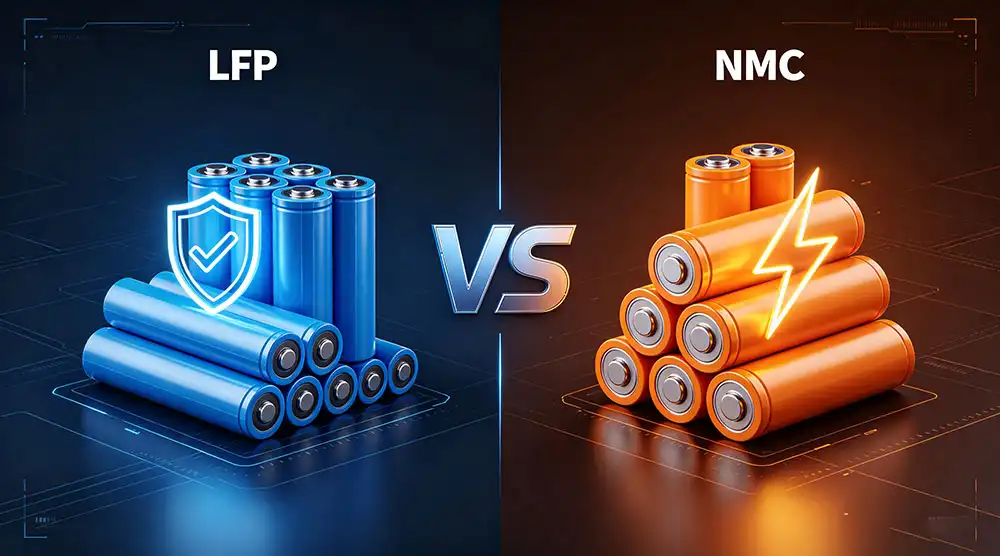
When selecting a battery energy storage system (BESS), one of the most critical decisions is the battery chemistry. The two dominant lithium-ion chemistries used in commercial and industrial energy storage are LFP (Lithium Iron Phosphate, LiFePO4) and NMC (Nickel Manganese Cobalt). This article compares both chemistries across the factors that matter most to project developers, EPC contractors, and facility managers.
What Is LFP Battery?
LFP (LiFePO4) uses lithium iron phosphate as the cathode material. It is widely adopted in stationary energy storage, electric buses, and backup power systems. LFP batteries are known for their excellent thermal stability, long cycle life, and inherent safety.
What Is NMC Battery?
NMC (Nickel Manganese Cobalt) uses a combination of nickel, manganese, and cobalt as the cathode material. NMC batteries offer higher energy density, making them popular in electric vehicles and compact portable electronics. In energy storage, NMC is used where space is limited and high energy output per unit volume is required.
Safety Comparison
Safety is the top priority in commercial energy storage. LFP batteries have a strong structural bond in their crystal lattice, which means they are far less likely to experience thermal runaway even under extreme conditions such as overcharging, short circuits, or physical damage. NMC batteries release oxygen at lower temperatures, which increases the risk of thermal runaway if the battery management system (BMS) fails.
For large-scale containerized BESS installations where fire suppression and ventilation may be limited, LFP is the safer choice.
Cycle Life Comparison
Cycle life determines how many charge-discharge cycles a battery can deliver before its capacity drops to 80% of the original rating.
LFP: 4,000 - 8,000 cycles (typically 6,000+ at 0.5C discharge rate)
NMC: 2,000 - 3,000 cycles (typically 2,500 at 0.5C discharge rate)
For energy storage applications where the battery cycles daily (one cycle per day for peak shaving), LFP can last 10-15+ years, while NMC may need replacement after 6-8 years.
Energy Density Comparison
LFP: ~150-160 Wh/kg (cell level)
NMC: ~200-250 Wh/kg (cell level)
NMC has a clear advantage in energy density. This means that for the same energy capacity, an NMC battery pack will be smaller and lighter. However, in stationary energy storage where the system is installed in a container or a dedicated room, size and weight are less critical than safety and longevity.
Cost Comparison
LFP batteries have become significantly cheaper in recent years due to the removal of cobalt and nickel from the cathode, which reduces raw material costs. As of 2025-2026, LFP cells are typically 15-20% cheaper than NMC cells per kWh.
Additionally, the longer cycle life of LFP means the total cost of ownership (TCO) over 10 years is significantly lower, as fewer battery replacements are needed.
Temperature Performance
LFP: Performs well at high temperatures, tolerating up to 60°C without significant degradation
NMC: Better performance at low temperatures (below -10°C), but degrades faster at high temperatures
For projects in hot climates such as Southeast Asia, the Middle East, and Africa, LFP is the better choice due to its heat tolerance.
Summary: Which Should You Choose?
For commercial and industrial energy storage, LFP is the recommended chemistry. Its combination of safety, long cycle life, lower cost, and excellent high-temperature performance makes it ideal for peak shaving, load shifting, and renewable energy integration.
XINREX Energy manufactures LFP-based commercial battery energy storage systems, including containerized BESS solutions from 100kWh to over 1MWh. Our systems use prismatic LFP cells with advanced BMS, liquid cooling, and fire suppression for maximum safety and reliability. Learn more about our energy storage solutions at https://xinrex.com.cn
Last Article:Reasons Why Lithium Battery Storage Is a Good Idea
Next Article:No More